

|
 あぜな (畔菜)
|
|
|
  |
|

|
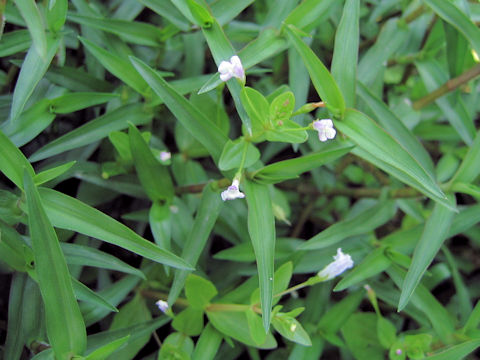
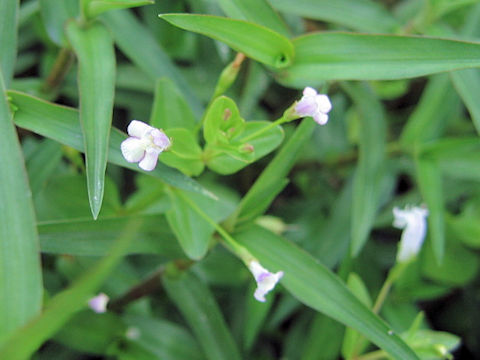
わが国の各地をはじめ、台湾や朝鮮半島、中国、アジア、ヨーロッパに広く分布しています。茎には4稜があり、下部で分枝します。葉は卵形から楕円形で対生し、3~4個の平行脈があります。8月から10月ごろ、葉腋から長い花柄をだして、淡い紅紫色の唇形花を咲かせます。水田の代表的な雑草のひとつです。台湾華語では「陌上草」、中国名では「陌上菜(mo shang cai)」です。 韓国語では「パットゥッウェプル(밭뚝밭뚝)」です。これは「畦(パットゥク: 밭뚝)」+「ウリに似た形の実がなる草(ウェプル: 밭뚝)」の合成語です。果実がマクワウリに似ていて、畑の畦や田んぼの畦に育つという意味に由来しています。 |
|
|
ゴマノハグサ科アゼトウガラシ属の一年草で、学名は Lindernia pyxidaria (syn. Lindernia procumbens)。英名は False pimpernel。 |
|
|
The False pimpernel (Lindernia pyxidaria) belongs to Scrophulariaceae (the Figwort family). It is an annual herb that is widely distributed throughout Japan, as well as Taiwan, the Korean Peninsula, China, Asia, and Europe. The stem has four ridges and is branched at the bottom. Leaves are ovate to elliptic, opposite, with three to four parallel veins. From August to October, long peduncles emerge from the leaf axils and produce pale reddish-purple labiate flowers. It is one of the most common weeds in paddy fields. In Taiwanese Chinese, it is called "陌上草" and in Chinese "陌上菜" (mo shang cai). In Korean, it's called "pat-ttuk-oe-pul" (밭뚝밭뚝). This is a compound word consisting of "ridge" (pat-ttuk: 밭뚝) + "a plant that bears fruit shaped like a gourd" (oe-pul: 밭뚝). The name comes from the fact that its fruit resembles a makuwa melon and it grows along the ridges of vegetable fields and rice paddies. |
|
|
大阪府交野市「大阪市大付属植物園」にて、2004年07月17日撮影。 |
|
|

|
Shu Suehiro shu@botanic.jp
|