
|

|
 あずまなるこ (東鳴子) |
[Index]
[Back]
|
|
|
       |
|

|
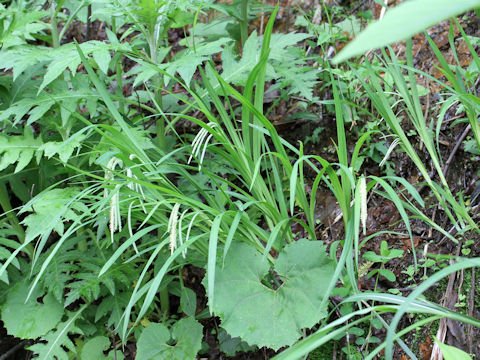
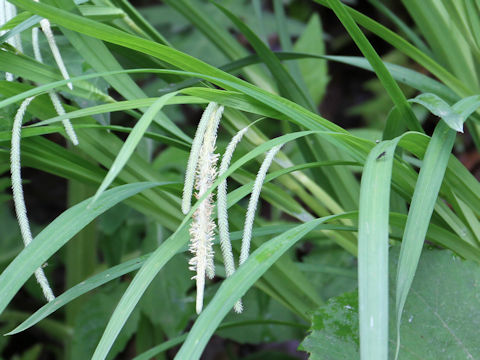
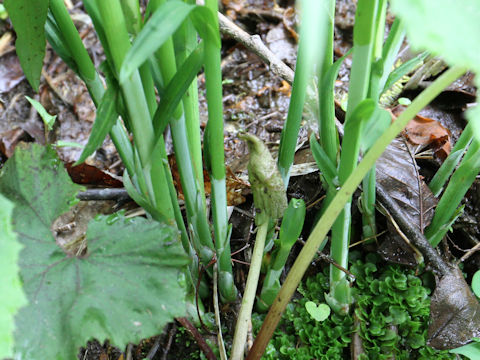
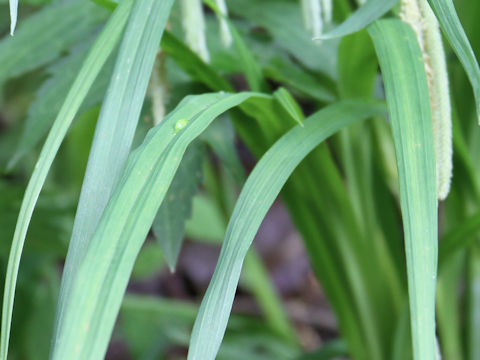
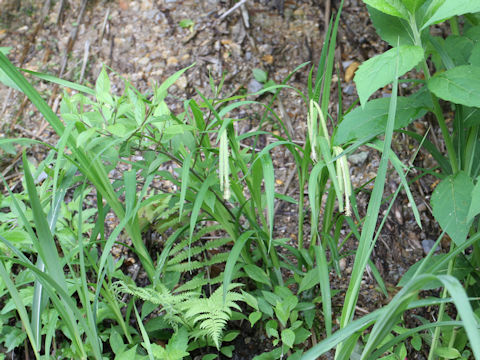
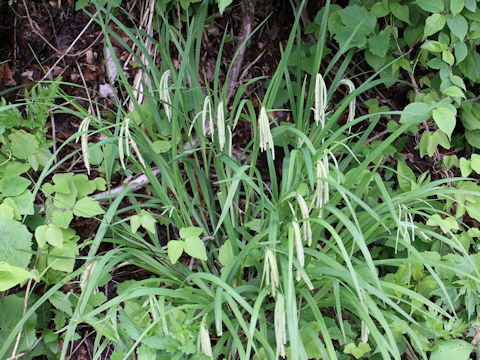
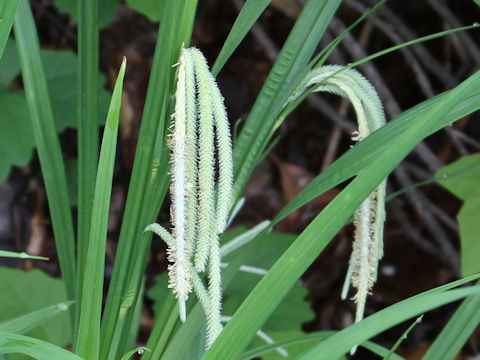
わが国の各地および韓国の江原道や鬱陵島(ウルルンとう)が原産です。本州では主に日本海側に、九州では北部にのみ分布しています。山地の水湿地に生え、高さは40~80センチになります。根茎は短く、叢生します。茎の基部は太くて丸く、葉身のない鞘に包まれています。葉は線形でやわらかく、幅は5~12ミリあります。4月から6月ごろ、花茎を伸ばして先端に垂れ下がった小穂を3~6個つけます。頂小穂の先端が雌性、基部が雄性の雌雄性で、それ以外の小穂は雌性です。 韓国語では「サンコリサチョ(산꼬리사초)」です。これは「山(サン: 산)」+「尻尾(コリ: 꼬리)」+「スゲ(莎草・サチョ: 사초)」の合成語です。山に生える尻尾のように細長く垂れ下がる小穂のあるスゲという意味です。 |
|
|
カヤツリグサ科スゲ属の多年草で、学名は Carex shimidzensis。英名はありません。 |
|
|
The "Azuma-naruko" (Carex shimidzensis) belongs to Cyperaceae (the Sedge family). It is a perennial herb that is native to various parts of Japan, as well as Gangwon Province and Ulleungdo in Korea. It is mainly distributed on the Sea of Japan side in Honshu and only in the northern part of Kyushu. This herb grows in wedlands of mountains and can reach 40-80 cm in height. The rhizomes are short and crowded. The base of the stem is thick and round, and is covered with a leafless sheath. The leaves are linear and soft, 5-12 mm wide. The 3-6 drooping spikes are borne on the terminal flowering stalks from April to June. The acrogyrous spike is bisexual, it consists of the female apical part and the male basal part. The other spikes are female. In Korean, it's called "san-kkori-sa-cho" (산꼬리사초). This is a compound word consisting of "mountain" (san: 산) + "tail" (kkori: 꼬리) + "sedge" (sa-cho: 사초). It refers to a type of sedge with slender, tail-like spikelets that hang down from the mountain. |
|
|
山形県小国町小玉川「樽口峠」にて、2020年05月22日撮影。 |
|
|

|
Shu Suehiro shu@botanic.jp |
|