
|

|
 えぞいぶきとらのお (蝦夷伊吹虎の尾) |
[Index]
[Back]
|
|
|
       |
|

|
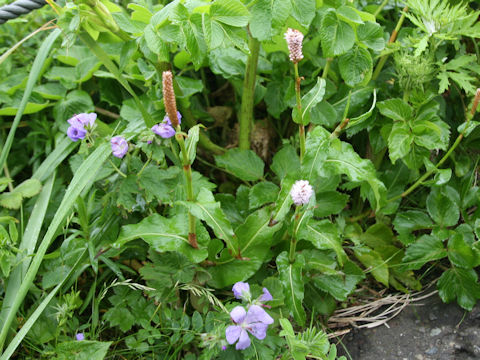
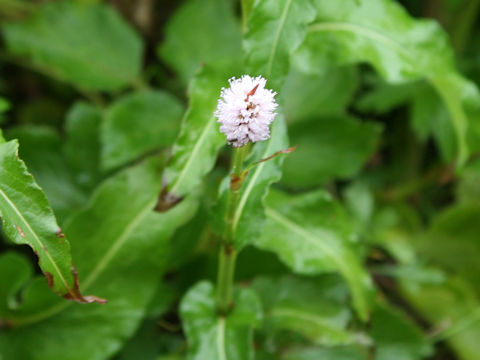
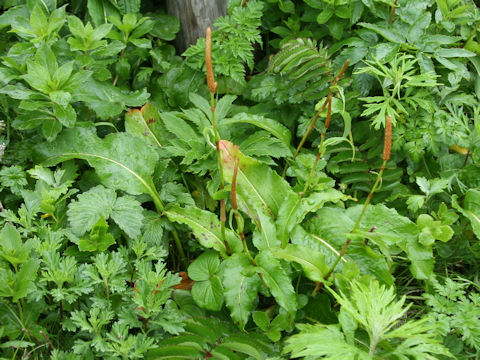
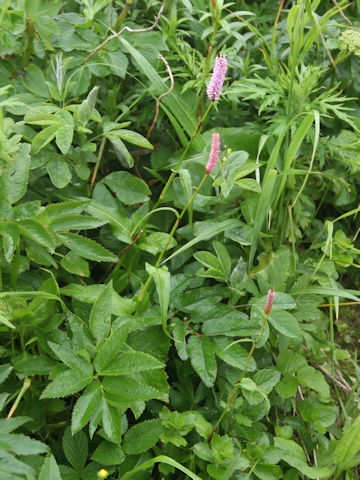
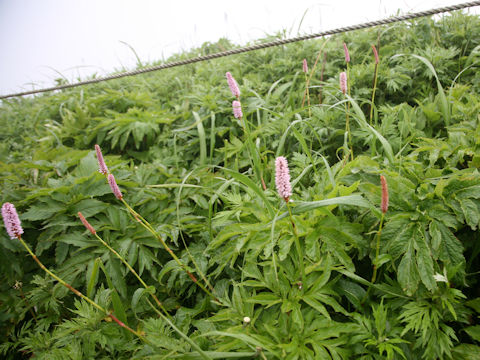
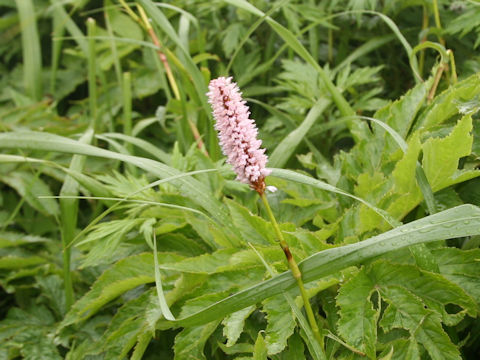
わが国の北海道、夕張山地や中央高地から利尻島、礼文島まで分布しています。それに朝鮮半島北部から中国東北部、極東ロシア、サハリンにも分布があります。海岸から高山にかけての草原などに生え、高さは30~100センチになります。「いぶきとらのお」よりも高くなります。根生葉は卵状楕円形で基部は心形、茎葉は根生葉に比べて小さいものです。7月から9月ごろ、茎頂に3~6センチほどの円柱花序をだし、白色から淡いピンク色の小さな花を密集して咲かせます。花弁はなく、8~10個の雄しべが長く突き出ています。中国語では「倒根拳参(dao gen quan shen)」と呼ばれます。 韓国語では「チャムボムッコリ(참범꼬리)」です。これは「真の(チャム: 참)」+「ポムッコリ(범꼬리)」の合成語です。「ポムッコリ」はこの円柱状の花序が、「虎の尾(범의 꼬리)」に見えることから名付けられています。 |
|
|
タデ科イブキトラノオ属の多年草で、学名は Bistorta officinalis ssp. pacifica (syn. Polygonum pacificum、Polygonum ochotense)。英名はありません。 |
|
|
The "Ezo-ibuki-torano-o" (Bistorta officinalis ssp. pacifica) belongs to Polygonaceae (the Knotweed family). It is a perennial herb that is found from the Yubari Mountains and the Central Highlands of Hokkaido to Rishiri Island and Rebun Island in Japan. It is also found in the northern Korean Peninsula, northeastern China, the Russian Far East, and Sakhalin. It grows in grasslands ranging from coastal areas to alpine regions and reaches a height of 30 to 100 cm. It grows taller than "Ibuki-torano-o". The basal leaves are ovate-elliptical with a heart-shaped base, while the stem leaves are smaller than the basal leaves. From July to September, it produces a cylindrical inflorescence about 3-6 cm long at the stem apex, bearing small, densely clustered flowers ranging in color from white to pale pink. The flowers lack petals, and 8-10 stamens protrude prominently. It is called "倒根拳参" (dao gen quan shen) in Chinese. In Korean, it's called "cham-beom-kko-ri" (참범꼬리). This is a compound word consisting of "true" (cham: 참) + "tiger's tail" (peom-kko-ri: 범꼬리). "peom-kko-ri" gets its name from the fact that this cylindrical inflorescence resembles a "tiger's tail". |
|
|
[上・中1~3] 北海道礼文町香深村シャクニンにて、2025年06月11日撮影。 [中4] 北海道礼文町香深村差閉にて、2025年06月11日撮影。 [中5・下] 北海道礼文町香深村知床にて、2025年06月11日撮影。 |
|
|

|
Shu Suehiro shu@botanic.jp |
|