
|

|
 おおつるうめもどき (大蔓梅擬き) |
[Index]
[Back]
|
|
|
    |
|

|
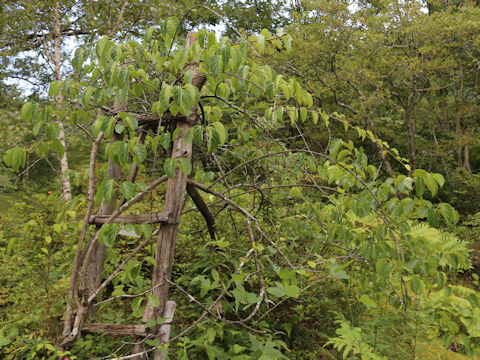
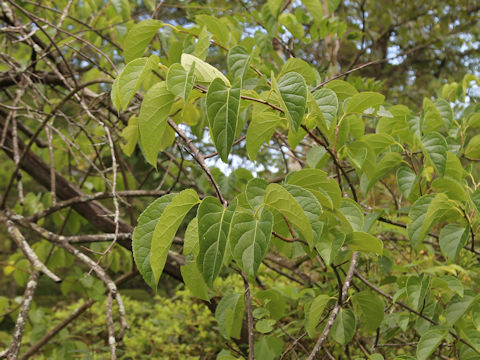
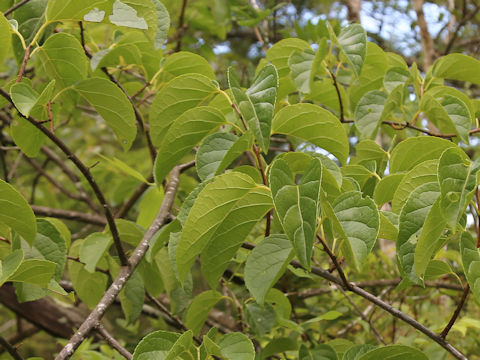
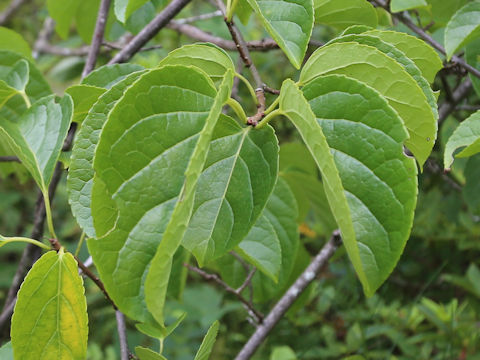
わが国の本州、岩手県以南から四国・九州、それに朝鮮半島南部に分布しています。山地の林縁に生え、蔓性で長さ数メートルになり、ほかの木の幹などまつわりついて這い登ります。葉は円形または広楕円形で、長さは6~12センチになり、縁には鈍鋸歯があります。また葉の基部は円形または広い楔形で、裏面は脈沿いに縮れた剛毛が密生します。5月から6月ごろ、葉腋から集散花序を出して、直径6~8ミリの黄緑色の花を咲かせます。果実は朔果で直径5~6ミリの球形、9月から11月に黄色に熟し、3裂して橙赤色の仮種皮に包まれた種子を出します。韓国語では「トルノバクトングル(털노박덩굴)」です。「毛(トル: 털)」+「ツルウメモドキ(ノバクトングル: 노박덩굴)」の合成語です。 |
|
|
ニシキギ科ツルウメモドキ属の落葉蔓性木本で、学名は Celastrus stephanotidifolius。英名はありません。 |
|
|
The "Oo-tsuru-umemodoki" (Celastrus stephanotidifolius) belongs to Celastraceae (the Bittersweet family). It is a deciduous vine that is distributed from Iwate Prefecture and southward on Honshu, through Shikoku and Kyushu, and into the southern part of the Korean Peninsula. It grows along the edges of mountain forests; it is a vine that can reach several meters in length and climbs by twining around the trunks of other trees. The leaves are round or broadly elliptical, 6-12 cm long, with bluntly serrated margins. The base of the leaf is round or broadly wedge-shaped, and the underside is densely covered with curly bristles along the veins. From around May to June, it produces corymbs from the leaf axils, bearing yellowish-green flowers 6-8 mm in diameter. The fruit is a capsule, spherical and 5-6 mm in diameter; it ripens to yellow from September to November, splits into three sections, and releases seeds enclosed in an orange-red aril. In Korean, it is called "털노박덩굴" (Teol-no-bak-deong-gul). It is a compound word consisting of "hairy" (털) and "Oriental bittersweet" (노박덩굴). |
|
|
宮城県仙台市太白区秋保町馬場「秋保大滝植物園」にて、2026年08月25日撮影。 |
|
|

|
Shu Suehiro shu@botanic.jp |
|