
|

|
 おぜそう (尾瀬草)
|
[Index]
[Back]
|
|
|
  |
|

|
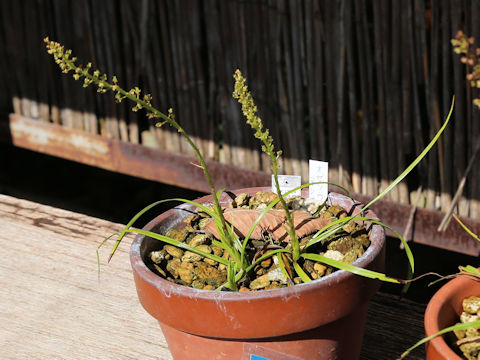
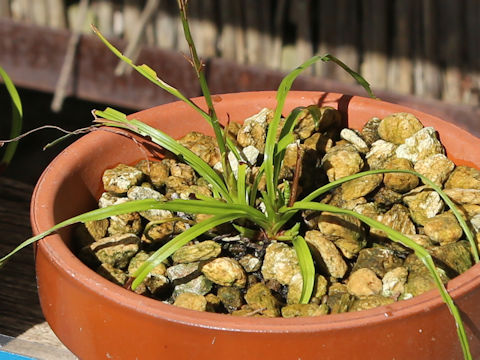
わが国の本州、中部地方の至仏山と谷川岳、それに北海道の天塩山地に分布しています。亜高山帯から高山帯の蛇紋岩地帯の湿った草地に生え、高さは10~20センチになります。葉は線形で根出し、7~9個の脈があります。7月から8月ごろ、花茎の先に長さ3~8センチの総状花序をだし、20~40個の淡い黄白色の花を咲かせます。果実は楕円形の蒴果です。和名や種小名は、発見地の至仏山のある尾瀬に因みます。別名で「てしおそう(天塩草)」とも呼ばれます。一属一種です。 |
|
|
サクライソウ科オゼソウ属の多年草で、学名は Japonolirion osense (syn. Japonolirion osense var. saitoi)。英名はありません。 |
|
|
The "Oze-so" (Japonolirion osense) belongs to the family Petrosaviaceae. It is a perennial herb that is found on Mount Shibutsu and Mount Tanigawa in the Chubu region of Honshu, as well as in the Teshio Mountains of Hokkaido. It grows in moist grasslands in serpentine rock areas ranging from the subalpine to the alpine zones, reaching a height of 10 to 20 cm. The leaves are linear, arising from the base of the stem, and have 7 to 9 veins. From around July to August, it produces a raceme 3-8 cm long at the tip of the flower stalk, bearing 20-40 pale yellowish-white flowers. The fruit is an elliptical capsule. Its Japanese name and specific epithet are derived from Oze, where Mount Shibutsu-the site of its discovery-is located. It is also known by the alternative name "Teshio-so". It is the sole species in its genus. |
|
|
北海道札幌市中央区「北海道大学植物園」にて、2026年09月30日撮影。 |
|
|

|
Shu Suehiro shu@botanic.jp
|
|