
|

|
 ふいりおおしまかんすげ (斑入り大島寒菅) |
[Index]
[Back]
|
|
|
  |
|

|
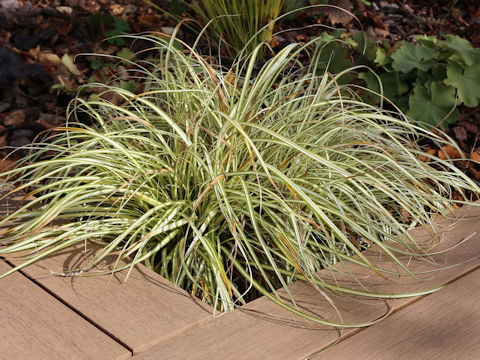
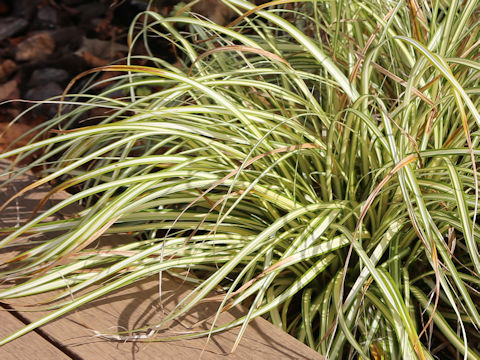
わが国の伊豆諸島や伊豆半島の一部に分布する「おおしまかんすげ」の斑入り品種です。葉は線形で叢生し、高さは20~50センチになります。葉は緑色で、その中央に鮮明なクリーム色や黄色の縦斑が入り、縁には細かく鋭い鋸歯があり、ざらつきます。春から初夏にかけて、稈の先端に頂小穂と数個の側小穂をつけます。頂小穂は雄性で、側小穂はふつう雌雄性です。耐寒性・耐暑性が強く、日なたから半日陰、日陰まで適応するので、グランドカバーや寄せ植えによく利用されます。 韓国での一般的な園芸流通名は「ムニサチョ(무늬사초)」です。これは「模様(ムニ: 무늬)」+「スゲ(サチョ: 사초)」の合成語です。 |
|
|
カヤツリグサ科スゲ属の常緑多年草で、学名は Carex oshimensis f. variegata。英名は Evergold sedge。 |
|
|
The Evergold sedge (Carex oshimensis f. variegata) belongs to Cyperaceae (the Sedge family). It is a perennial evergreen herb that is a variegated variety of "Oshima-kan-suge", which is native to Japan's Izu Islands and parts of the Izu Peninsula. The leaves are linear and grow in clumps, reaching a height of 20 to 50 cm. The leaves are green with distinct cream-colored or yellow vertical stripes down the center; they have fine, sharp serrations along the edges and feel rough to the touch. From spring through early summer, it produces a terminal spikelet and several lateral spikelets at the tips of the stems. The terminal spikelet is male, while the lateral spikelets are typically hermaphroditic. It is highly resistant to both cold and heat and adapts well to conditions ranging from full sun to partial shade and even full shade, making it a popular choice for groundcover and mixed plantings. In South Korea, it is commonly known in the horticultural trade as "mu-nui-sa-cho" (무늬사초). This is a compound word consisting of "pattern" (mu-nui: 무늬) and "sedge" (sa-cho: 사초). |
|
|
北海道白老町若草町「ウポポイ」にて、2026年10月01日撮影。 |
|
|

|
Shu Suehiro shu@botanic.jp |
|