
|

|
 ひじはりのき (肘張りの木)
|
[Index]
[Back]
|
|
|
   |
|

|
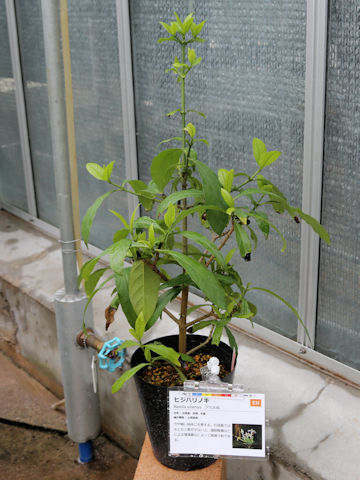
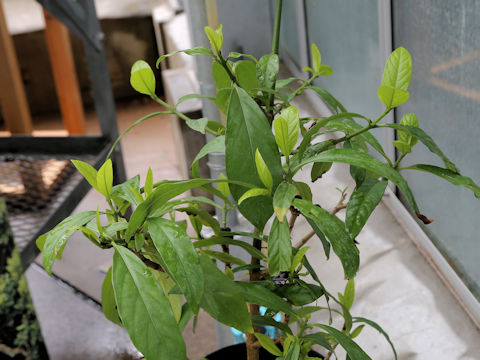
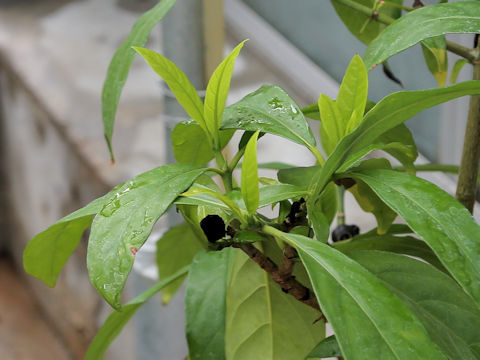
わが国の八重山群島にある石垣島、それに台湾や中国南部、インドシナ半島に分布しています。石灰岩地の林内や林縁に生え、高さは1~4メートルになります。葉は長楕円形から長楕円状披針形で薄い革質、縁は全縁で対生します。葉の葉腋からは硬く鋭い刺が出ます。2月から5月ごろ、枝先に散房花序をだし、白色の筒状花を咲かせます。花冠の先端は4~5裂します。和名は、小枝を真横に出す様子を、人が肘を張っている姿に見立てたもの。環境省のレッドブックでは絶滅危惧IB類(EN)に指定されています。別名で「しなみさおのき(支那操の木)」、台湾華語では「華茜草樹」、中国語では「簕茜(le qian)」と呼ばれます。 |
|
|
アカネ科ヒジハリノキ属の常緑低木で、学名は Benkara sinensis (syn. Randia sinensis)。英名は Chinese randia。 |
|
|
The Chinese randia (Benkara sinensis) belongs to Rubiaceae (the Madder family). It is a small evergreen tree that is found on Ishigaki Island in Japan's Yaeyama Islands, as well as in Taiwan, southern China, and the Indochina Peninsula. It grows in forests and along forest edges in limestone areas and reaches a height of 1 to 4 m. The leaves are oblong to oblong-lanceolate, thin and leathery, with entire margins, and are arranged in opposite pairs. Hard, sharp thorns emerge from the leaf axils. From February to around May, it produces corymbs at the tips of its branches, bearing white, tubular flowers. The tips of the corolla are 4-5 lobed. The Japanese name is derived from the resemblance of the plant's lateral branches extending straight out to a person with their elbows spread wide. It is listed as Endangered (EN) in the Ministry of the Environment's Red List. In Taiwanese Chinese, it is called "華茜草樹", and "簕茜" (le qian) in Chinese. |
|
|
茨城県つくば市「つくば実験植物園」にて、2026年03月28日撮影。 |
|
|

|
Shu Suehiro shu@botanic.jp
|
|