
|

|
 げじげじしだ (蚰蜒蚰蜒羊歯)
|
[Index]
[Back]
|
|
|
     |
|

|
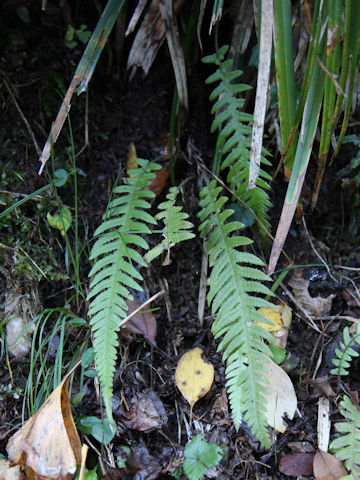
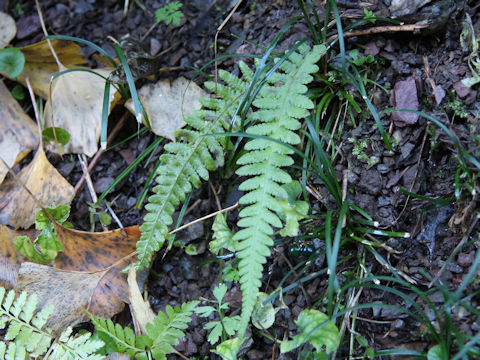
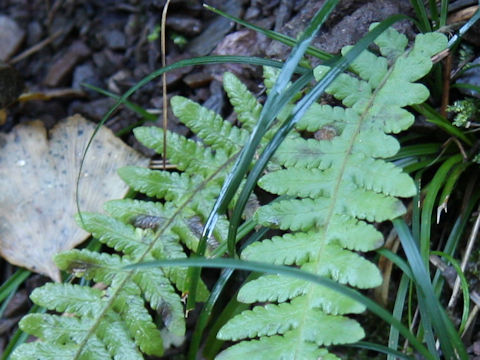
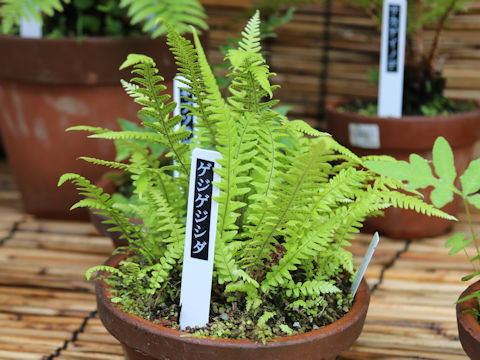
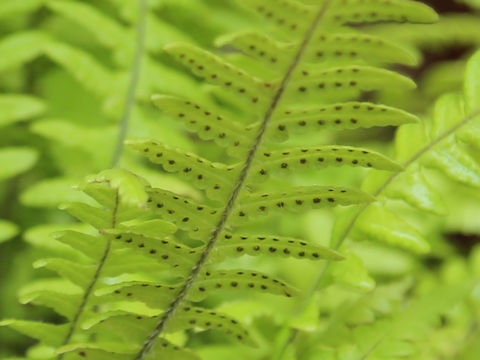
わが国の各地をはじめ、台湾や朝鮮半島南部、中国、インドシナ半島それにインドに分布しています。山地の林縁や石垣などに生え、長さは20~50センチになります。葉は単羽状から2回羽状深裂です。羽片は披針形で、下部羽片は短くなります。台湾華語では「短柄卵果蕨」、中国語では「延羽卵果蕨(yan yu luan guo jue)」と呼ばれます。 |
|
|
ヒメシダ科ヒメシダ属の夏緑性シダ類で、学名は Thelypteris decursive-pinnata。英名は Japanese beech fern。 |
|
|
The Japanese beech fern (Thelypteris decursive-pinnata) belongs to the Thelypteridaceae family. It is a summer-green fern that is native throughout Japan, as well as Taiwan, the southern Korean Peninsula, China, the Indo-China Peninsula and India. This fern grows in mountain forest edges or stone walls, and can reach 20-50 cm long. The leaves are unipennate to twice deep pinnately. The pinnae are lanceolate and the underneath pinnae are shorter than other parts. In Taiwanese Chinese, it is called "短柄卵果蕨" and "延羽卵果蕨" (yan yu luan guo jue) in Chinese. |
|
|
[上・中1~2] 埼玉県越生町黒山にて、2010年12月04日撮影。 [中3・下] 宮城県仙台市太白区秋保町馬場「秋保大滝植物園」にて、2026年07月28日撮影。 |
|
|

|
Shu Suehiro shu@botanic.jp
|
|