
|

|
 かんこくだいこん (韓国大根)
|
[Index]
[Back]
|
|
|
   |
|

|
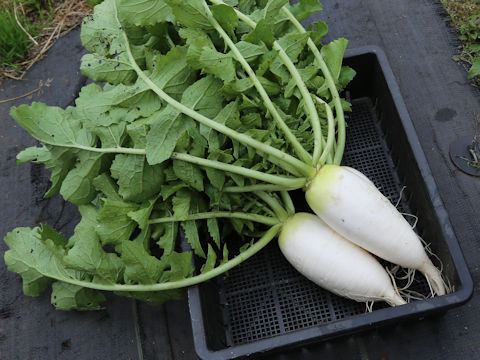
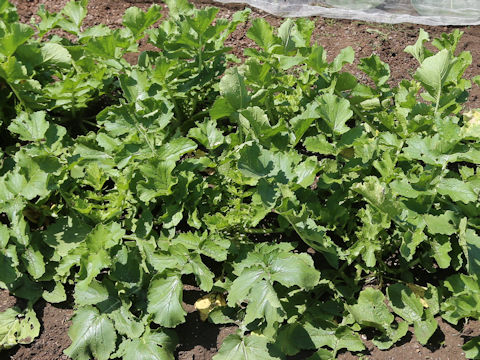
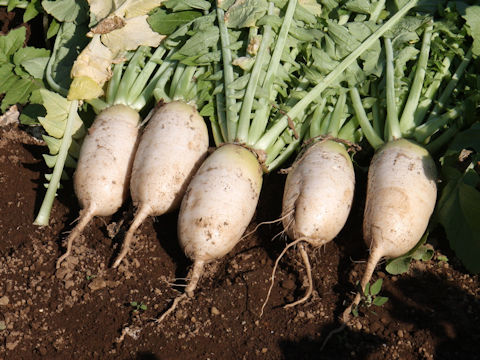
中国の華北系大根の系統に属します。わが国の青首大根に比べて太く、ずんぐりとした楕円形や円柱形に近い形で、根長は20~30センチになります。肉質は水分がやや少なめで、身が固く締まり、甘みと辛みのバランスが良いのが特徴です。韓国では「チョソンム」(조선무 朝鮮大根)と呼ばれ、「カクテキ(깍두기)」や「ムセンチェ(무생채)」など、食感を活かしたキムチに利用されています。産地は北東部の江原特別自治道にある高冷地の大関嶺(テグァルリョン: 대관령)や陳富嶺(チンブリョン: 진부령)などが有名です。わが国では埼玉県日高市(高句麗からの渡来人が集住したかつての高麗郡)が韓国白菜や韓国大根の産地です。 写真上・中の品種は、「テヨン(大淵: 대연)」 下は、「ホワイトジェム(White Jem)」 |
|
|
アブラナ科ダイコン属の一年草で、学名は Raphanus sativus var. hortensis (syn. Raphanus sativus var. longipinnatus)。英名は Korean radish、Mu (무)。 |
|
|
The Korean radish (Raphanus sativus var. hortensis) belongs to Brassiaceae (the Mustard family). It is an annual herb that belongs to the North China radish lineage. Compared to Japan's green-top radish, it is thicker and has a stout, oval or nearly cylindrical shape, with a root length of 20 to 30 cm. Its flesh is characterized by a slightly lower water content, a firm texture, and a good balance of sweetness and spiciness. In South Korea, it is called "Joseonmu" (조선무) and is used in kimchi varieties such as "Kakdugi" (깍두기) and "Musaengchae" (무생채), which make the most of its unique texture. Famous production areas include the high-altitude regions of Daegwallyeong (대관령) and Jinburyeong (진부령) in Gangwon Special Self-Governing Province in the northeast. In Japan, Hidaka City in Saitama Prefecture (formerly Koryo County, where immigrants from Goguryeo settled) is a major producer of Korean Chinese cabbage and Korean radish. |
|
|
[上] 宮城県川崎町支倉にて、2026年06月02日撮影。 [中] 同上にて、2026年05月31日撮影。 [下] 千葉県香取市大角にて、2011年11月17日撮影。 |
|
|

|
Shu Suehiro shu@botanic.jp
|
|