 |
|

|
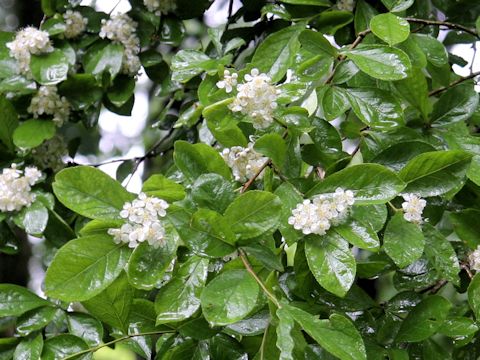
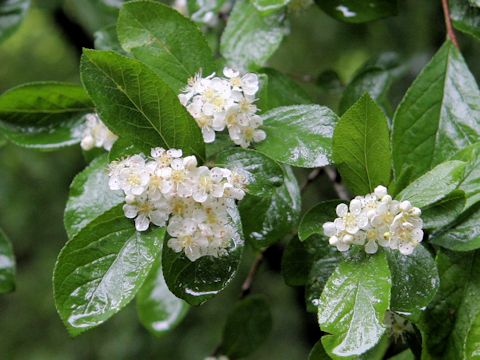
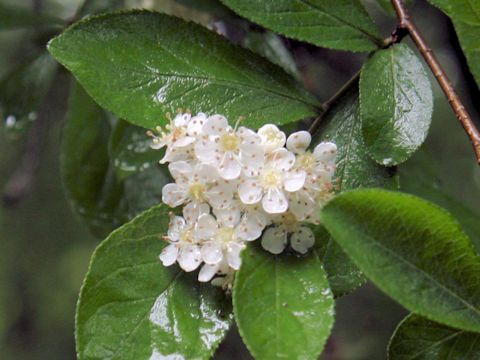
わが国の各地をはじめ、朝鮮半島から中国にかけて分布しています。山地の日当たりのよい林縁などに生え、高さは5~7メートルになります。葉は倒卵状長楕円形で、「かまつか」より厚く大きいのが特徴です。若い枝や葉柄、葉の裏面、萼などに白色の軟毛があります。別名で、「うすげかまつか(薄毛鎌柄)」とも呼ばれます。中国語では「毛葉石楠(mao ye shi nan)」と呼ばれます。
韓国語では「ユンノリナム(윤노리나무)」です。これは「ユンノリ(윤노리)」+「木(ナム: 나무)」の合成語です。「ユンノリ」とは韓国の伝統的な双六遊びで、このゲームに使う棒(ユッ)を作るのに適していたことから名付けられました。
|
|
|
バラ科カマツカ属の落葉低木で、学名は Pourthiaea vilosa var. zollingeri (syn. Pourthiaea villosa var. villosa)。英名はありません。
|
|
|
The "Ke-kamatsuka" (Pourthiaea vilosa var. zollingeri) belongs to Rosaceae (the Rose family). It is a small deciduous tree that is distributed throughout Japan, as well as the Korean Peninsula and China. This tree grows in sunny mountain forest edges and can reach 5-7 m in height. The leaves are obovate-oblong and defined by thicker and larger than Smooth oriental photinia's ones. The young branches, petioles, abaxial sides of leaves and calyxes have white soft hairs. It is called "毛葉石楠" (mao ye shi nan) in Chinese.
In Korean, it's called "yun-no-ri-na-mu" (윤노리나무). This is a compound word consisting of "yun-no-ri" (윤노리) + "tree" (na-mu: 나무). "yun-no-ri" is a traditional Korean board game named after the fact that it was well-suited for making the sticks (yun) used in the game.
|
|
|
栃木県日光市「東京大学付属日光植物園」にて、2012年06月09日撮影。
|

 けかまつか (毛鎌柄)

 shu@botanic.jp