
|

|
 くろほおずき (黒酸漿)
|
[Index]
[Back]
|
|
|
     |
|

|
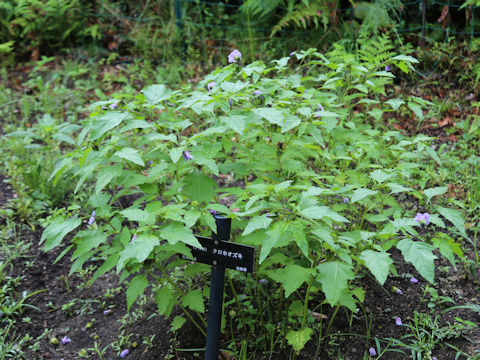
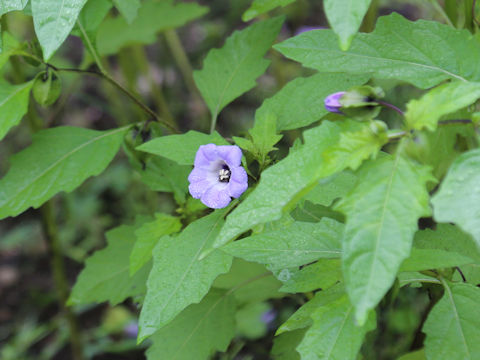
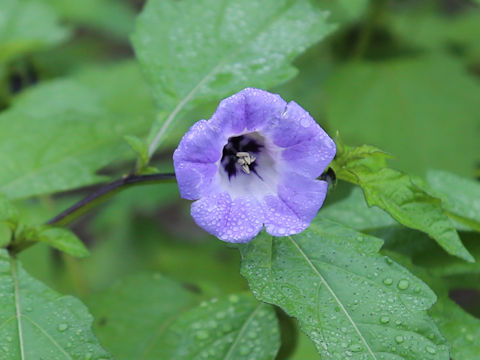
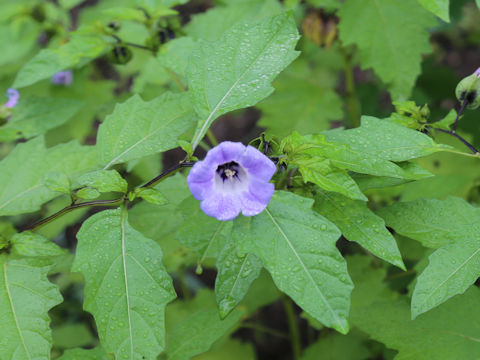
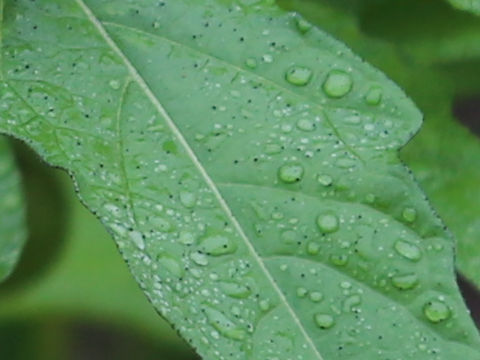
南アメリカのペルーからチリに分布する「おおせんなり(大千成)」の園芸品種です。1906年にフランスの育種家、アンリ・ルモワンヌによって作出されました。高さは60~80センチになります。草姿も花姿も「おおせんなり」によく似ていますが、葉の表面に小さな黒色をした棘状の突起が見られる点で区別できます。7月から9月ごろ、葉腋にやや濃いめの青紫色で、直径25ミリほどの花を咲かせます。茎や萼片、花冠の底部などが黒紫色を帯びているのも特徴です。果実は「ほおずき」に似た袋状の萼に包まれた、直径10~15ミリの球形の液果で、萼の上部が青黒色となります。果実にはトロパンアルカノイドが含まれ有毒です。 |
|
|
ナス科ニカンドラ属の一年草で、学名は Nicandra physalodes cv. Violacea。英名は Violet-stemmed apple of Peru、Shoo-fly plant。 |
|
|
The Violet-stemmed apple of Peru (Nicandra physalodes cv. Violacea) belongs to Solanaceae (the Nightshade family). It is an annual herb that is a horticultural variety of "Apple of Peru", native to South America, ranging from Peru to Chile. It was developed in 1906 by the French breeder Henri Lemoine. It grows to a height of 60 to 80 cm. While its overall appearance and flower form closely resemble those of "Apple of Peru", it can be distinguished by the small, black, spine-like projections visible on the surface of its leaves. From around July to September, it produces flowers in the leaf axils that are a somewhat deep bluish-purple color and about 25 mm in diameter. Another characteristic is that the stems, sepals, and the base of the corolla have a blackish-purple tint. The fruit is a spherical berry 10-15 mm in diameter, enclosed in a pouch-like calyx similar to that of the "Winter cherry", with the upper part of the calyx turning blue-black. The fruit contains tropane alkaloids and is poisonous. |
|
|
宮城県仙台市太白区秋保町馬場「秋保大滝植物園」にて、2026年07月28日撮影。 |
|
|

|
Shu Suehiro shu@botanic.jp
|
|