
|

|
 まめあさがお (豆朝顔)
|
[Index]
[Back]
|
|
|
            |
|

|
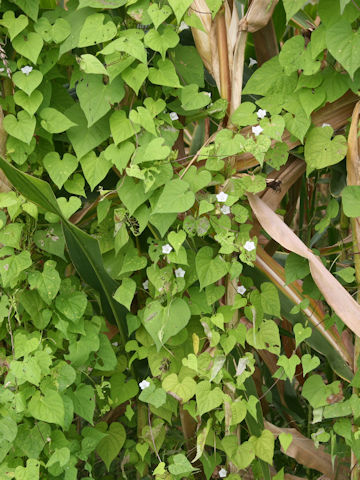
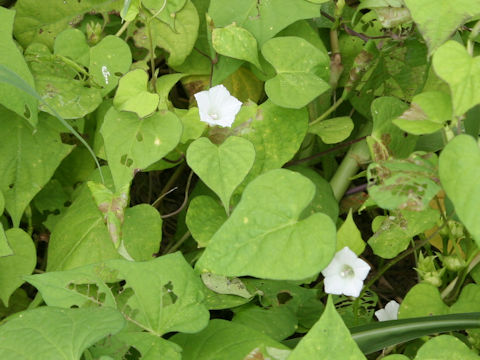
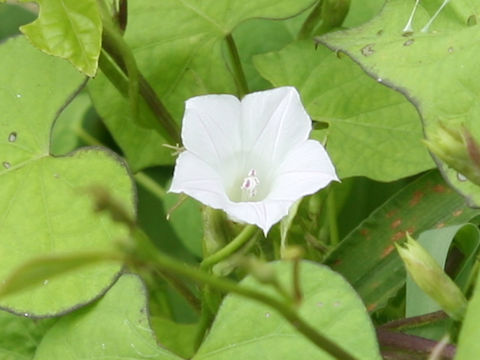
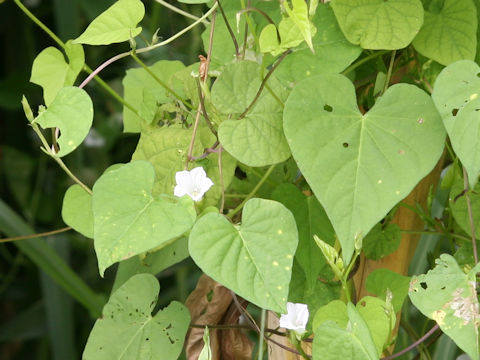
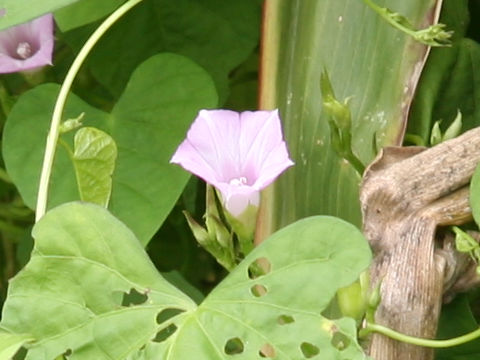
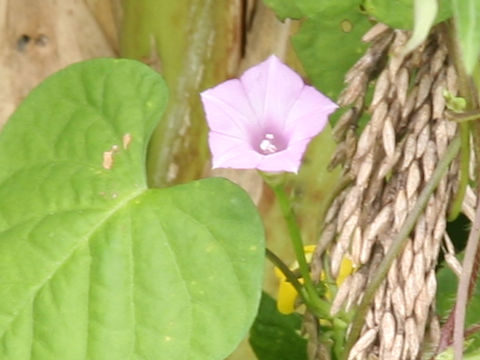
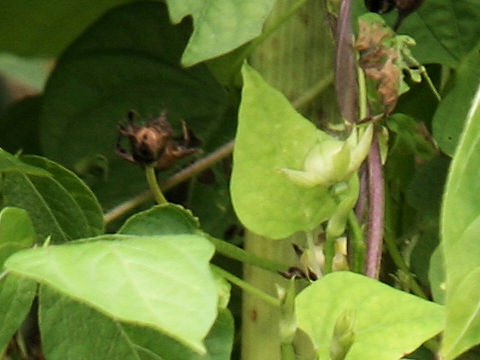
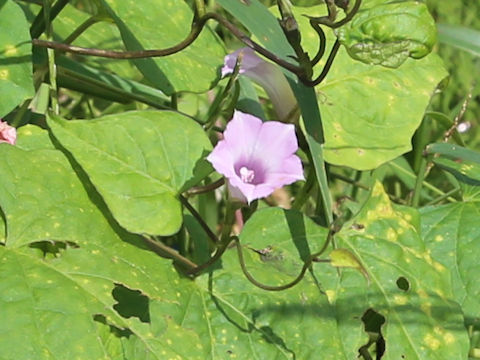
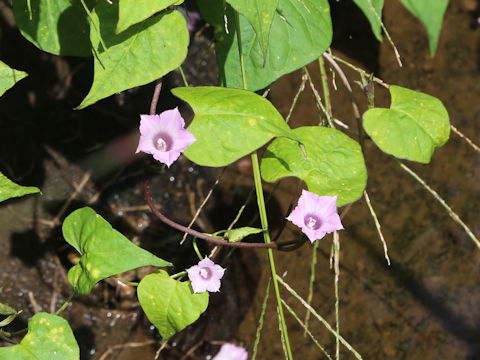
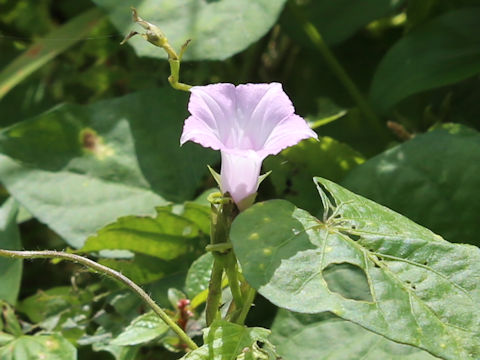
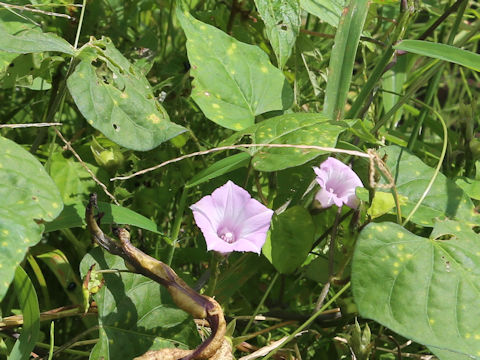
アメリカの中部および東部が原産です。わが国へは遅くとも1940年から1950年代には。輸入穀物に混入して渡来したと考えられています。現在では、関東地方から西に地域でふつうに見ることができます。草地や畑地、道ばたなどに生え、蔓性で他の植物などに巻きついて、長さは数メートルになります。葉は長さ5~10センチほどの卵形から長卵形で、変化が大きいです。7月から9月にかけて、直径15ミリほどの小さな花を咲かせます。花冠はふつう白色で、まれに淡紅色のものもあります。淡紅色の品種は「べにばなまめあさがお(紅花豆朝顔)」と呼ばれます。花柄には稜があり、いぼ状の突起が密生します。果実は扁平球形の蒴果で、種子が4個入っています。中国語では「瘤根甘薯(liu gen gan shu)」と呼ばれます。 韓国語では「エギナパルコッ(애기나팔꽃)」です。これは「小さい(エギ: 애기)」+「アサガオ(ナパルコッ: 나팔꽃)」の合成語です。 写真中5~6、中8~10・下は、「べにばなまめあさがお(紅花豆朝顔)」。 |
|
|
ヒルガオ科サツマイモ属の一年草で、学名は Ipomoea lacunosa。英名は Whitestar、Pitted morning-glory。 |
|
|
The Whitestar (Ipomoea lacunosa) belongs to Convolvulaceae (the Morning glory family). It is an annual herb that is native to the central and eastern United States. It is thought to have arrived in Japan between the 1940s and 1950s at the latest, mixed in with imported grains. Today, it is commonly found in areas west of the Kanto region of Honshu. It grows in grasslands, fields, roadsides, etc. It is a vine that grows several meters long, wrapping around other plants. The leaves are 5 to 10 cm long, ovate to long ovate, and vary widely. The corolla is usually white, but rarely light red. The light red variety is called "Ipomoea lacunosa f. purpurata". The peduncle has ribs and is densely covered with wart-like projections. The fruit is a flattened spherical capsule with four seeds. It is called "瘤根甘薯" (liu gen gan shu) in Chinese. In Korean, it's called "aegi-napal-kkot" (애기나팔꽃). This is a compound word consisting of "small" (aegi: 애기) and "morning glory" (napal-kkot: 나팔꽃). |
|
|
[上・中1~7] 宮城県大河原町西にて、2024年09月07日撮影。 [中8~10・下] 宮城県大河原町金ヶ瀬にて、2026年09月17日撮影。 |
|
|

|
Shu Suehiro shu@botanic.jp
|
|