

|
 みやまおだまき (深山苧環) |
|
|
                 |
|

|
わが国の本州、中部地方以北から北海道、それに朝鮮半島北部から中国東北部、南千島やサハリンに分布しています。高山帯の岩場や砂礫地に生えて、高さは10~25センチになります。6月から7月ごろ、青紫色の花を咲かせます。外側は青紫色の萼片で、内側の花弁の先端は白色です。基部は長く伸びて距になっています。中国語では「白山耬斗菜(bai shan lou dou cai)」と呼ばれます。 韓国語では「サンメバルトプ(산매발톱)」または「サンメバルトプコッ(산매발톱꽃)」です。これは「山(サン: 산)」+「オダマキ(メバルトプ: 매발톱)」の合成語です。「メバルトプ」は、「鷹の爪」という意味で、花の距の形がタカの爪に似ていることから名付けられています。 |
|
|
キンポウゲ科オダマキ属の多年草で、学名は Aquilegia flavellata var. pumila (syn. Aquilegia japonica)。英名はありません。 |
|
|
The "Miyama-odamaki" (Aquilegia flavellata var. pumila) belongs to Ranunculaceae (the Buttercup family). It is a perennial herb that is found from the Chubu region and northward on Honshu and Hokkaido in Japan, as wll as the northern part of the Korean Peninsula, northeastern China, the Southern Kuril Islands, and Sakhalin. This herb grows in alpine rocky places or gravels and can reach 10-25 cm in height. The blue-purple flowers bloom from June to July. The outer sepals are blue-purple and the inner petals have white tips. The each sepal has a long spur. It is called "白山耬斗菜" (bai shan lou dou cai) in Chinese. In Korean, it's called "san-mae-bal-top" (산매발톱) or "san-mae-bal-top-kkot" (산매발톱꽃). This is a compound word consisting of "mountain" (san: 산) + "columbine" (mae-bal-top: 매발톱). "mae-bal-top" means "hawk's claw" and was named because the shape of the flower's spur resembles a hawk's claw. |
|
|
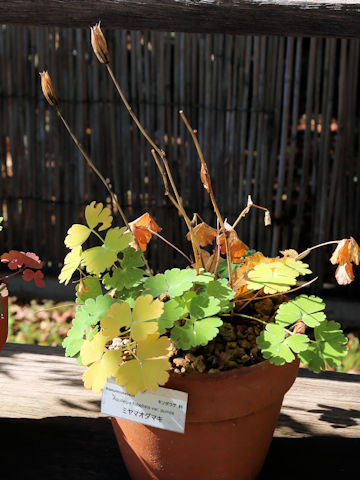
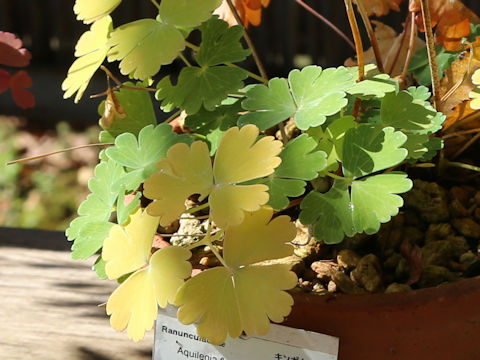
[上・中1] 大阪市鶴見区「咲くやこの花館」にて、2003年10月19日撮影。 [中2] 同上にて、2005年12月07日撮影。 [中3~中9] 岩手県遠野市「早池峰山」にて、2017年07月20日撮影。 [中10・中11] 北海道礼文町香深村入舟にて、2025年06月11日撮影。 [中12~中14] 北海道礼文町香深村知床にて、2025年06月11日撮影。 [中15・下] 北海道札幌市中央区「北海道大学植物園」にて、2026年09月30日撮影。 |
|
|

|
Shu Suehiro shu@botanic.jp |