
|

|
 ながぼのしろわれもこう (長穂の白吾木香) |
[Index]
[Back]
|
|
|
                |
|

|
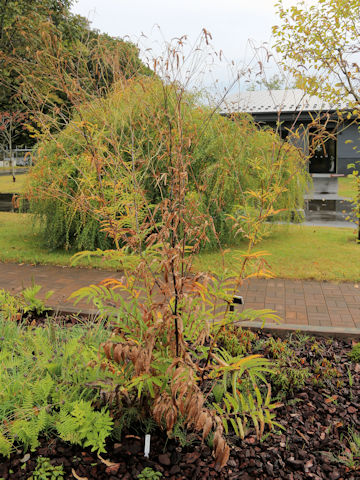
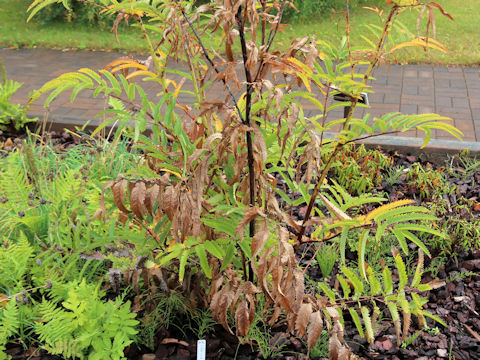
わが国の本州、関東地方以北から北海道、それに朝鮮半島や中国の東北部、極東ロシアに分布しています。湿原や湿性の草原などに生え、高さは1メートルほどになります。葉は奇数羽状複葉で、小葉は長楕円状線形で11~15個がつきます。また、縁には鋭い三角形の鋸歯があります。8月から10月ごろ、花茎をだして、白色の穂状花序をつけます。花弁はなく、4個の白色の萼片がつきます。雄しべは4本で長く、黒い葯が目立ちます。中国語では「小白花地楡(xiao bai hua di yu)」と呼ばれます。 韓国語では「カヌノイプル(가는오이풀)」です。これは「細い(カヌン: 가는)」+「ワレモコウ(オイプル: 오이풀)」の合成語です。「オイプル」は直訳すると「キュウリ草」ですが、これはワレモコウの葉を揉むとキュウリのような香りがする特徴に由来しています。 |
|
|
バラ科ワレモコウ属の多年草で、学名は Sanguisorba tenuifolia var. alba (syn. Sanguisorba tenuifolia)。英名はありません。 |
|
|
The "Nagabono-shiro-waremokou" (Sanguisorba tenuifolia var. alba) belongs to Roasaceae (the Rose family). It is a perennial herb that is distributed northward from Kanto district of Honshu to Hokkaido, as well as on the Korean Peninsula, in northeastern China, and in the Russian Far East. This herb grows in moors and wettish grasslands, and can reach about 1 m in height. The leaves are odd-pinnate compound with 11-15 oblong-linear leaflets. They have acute deltoid edges. The white spikes are borne on the fowering stalks from August to October. The flowers have not petals, on instead four petal-like calyx lobes. The four stamens are long with conspicuous black anthers. It is called "小白花地楡" (xiao bai hua di yu) in Chinese. In Korean, it's called "ka-neun-o-i-pul" (가는오이풀). This is a compound word consisting of "thin" (ka-neun: 가는) + "Great burnet" (o-i-pul: 오이풀). "o-i-pul" literally translates to "cucumber grass", a name derived from the fact that the leaves of the Great burnet give off a cucumber-like scent when rubbed. |
|
|
[上・中1] 福島県昭和村「矢ノ原湿原」にて、2012年08月26日撮影。 [中2・中3] 福島県北塩原村「デコ平湿原」にて、2014年09月07日撮影。 [中4~中6] 愛知県名古屋市港区「ブルーボネット」にて、2017年08月03日撮影。 [中7・中8] 山形県川西町「川西ダリヤ園」にて、2017年10月24日撮影。 [中9・中10] 青森県弘前市「弘前市りんご公園」にて、2020年10月25日撮影。 [中11~中13] 北海道豊富町西豊富「サロベツ原生花園」にて、2025年06月12日撮影。 [中14・下] 北海道白老町若草町「ウポポイ」にて、2026年10月01日撮影。 |
|
|

|
Shu Suehiro shu@botanic.jp |
|