
|

|
 のばりのぎく (粘り野菊) |
[Index]
[Back]
|
|
|
       |
|

|
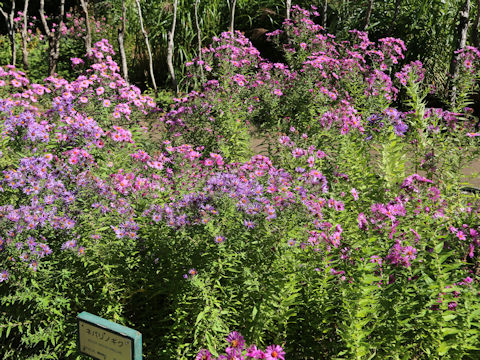
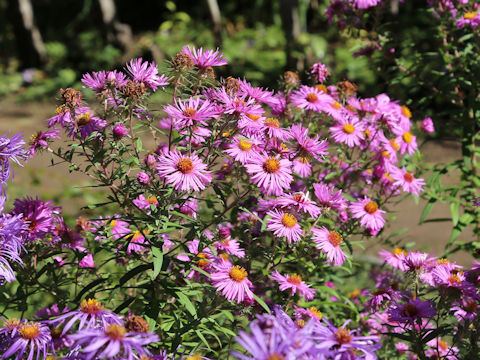
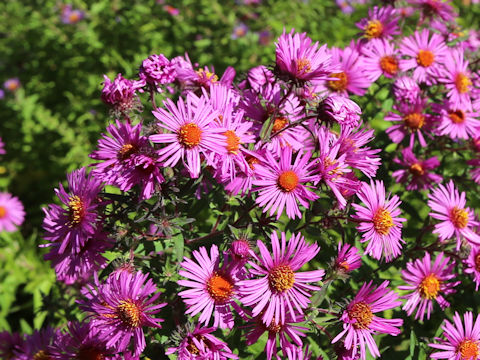
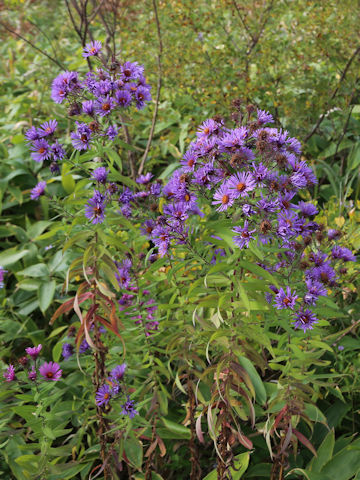
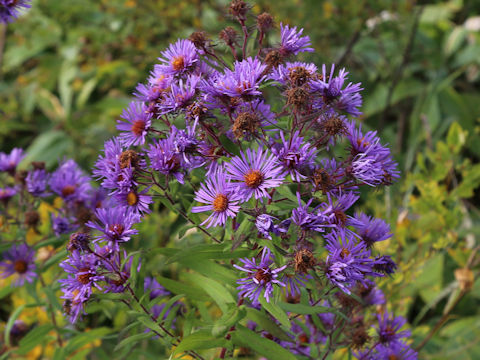
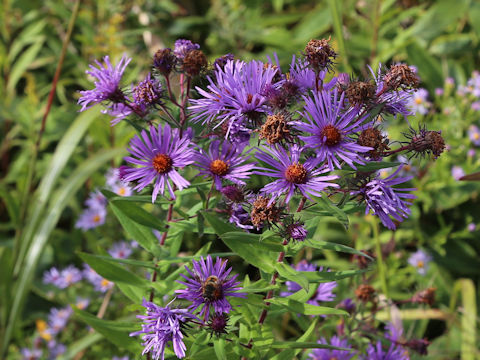
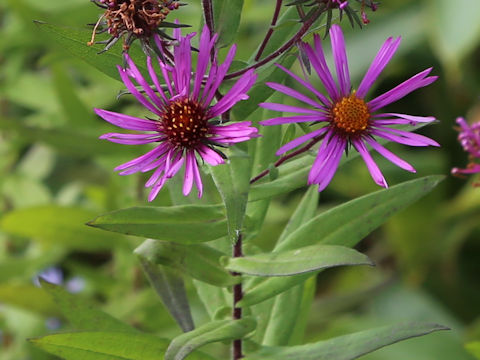
北アメリカの東部から中央部に分布しています。林縁や湿り気のある草原、川の土手などに生え、高さは90~180センチなります。わが国へは、大正時代に観賞用として持ち込まれましたが、現在では北海道を中心に、各地も野生化しています。葉は槍形で、基部に2つの突出した裂片があり、軟毛に被われています。8月から10月ごろ、茎頂に散房花序をだし、鮮やかな紫色やピンク色の頭花を咲かせます。頭花は直径20~35ミリ、中央の黄色い管状花の花房を取り囲むように、40個以上の舌状花で構成されています。和名は、葉や茎にある繊毛から粘着液が出て粘ることに因みます。 韓国語では「ニューイングランドアスター(뉴잉글랜드아스터)」です。これは英語名の音訳です。 |
|
|
キク科シオン属の多年草で、学名は Aster novae-angliaei (syn. Symphyotrichum novae-angliaei)。英名は New England aster。 |
|
|
The New England aster (Aster novae-angliaei) belongs to Asteraceae (the Aster family). It is a perennial herb that is native to eastern and central North America. It grows along forest edges, in moist grasslands, and on riverbanks, reaching a height of 90 to 180 cm. It was introduced to Japan during the Taisho era (1912-1926) as an ornamental plant, but has since naturalized in various regions, particularly in Hokkaido. The leaves are lanceolate, with two prominent lobes at the base, and are covered with soft hairs. From August through October, it produces corymbs at the tips of its stems, bearing vivid purple or pink flower heads. The flower heads are 20-35 mm in diameter and consist of more than 40 ray florets arranged around a central cluster of yellow tubular florets. Its Japanese name derives from the sticky substance secreted by the fine hairs on its leaves and stems. In Korean, it's called "New England aster" (nyu-ing-gul-raen-deu-a-seu-teo: 뉴잉글랜드아스터). This is a phonetic transcription of the English name. |
|
|
{上・中1~2] 北海道札幌市中央区「北海道大学植物園」にて、2026年09月30日撮影。 [中3~5・下] 北海道苫小牧市美沢にて、2026年10月01日撮影。 |
|
|

|
Shu Suehiro shu@botanic.jp |
|