
|

|
 たにむらあおい (谷村葵)
|
[Index]
[Back]
|
|
|
   |
|

|
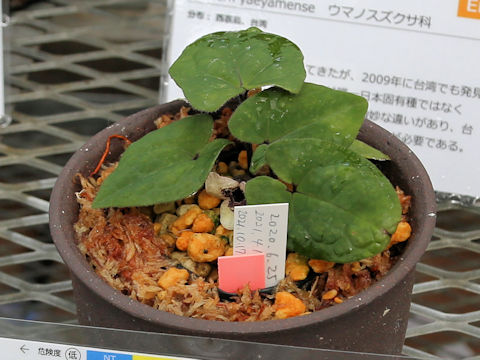
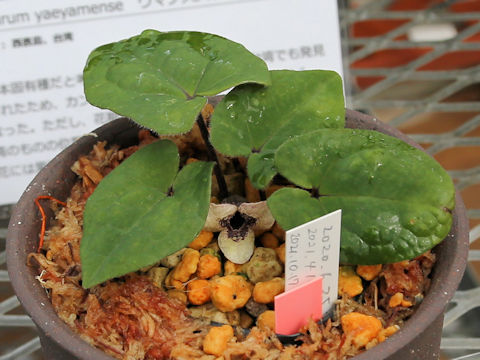
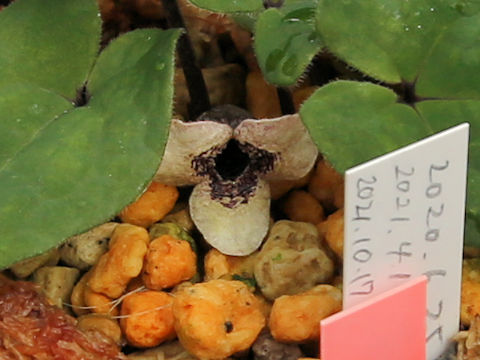
わが国の奄美群島にある徳之島の固有種です。石灰岩層の森林斜面だけに生え、高さは10~20センチになります。葉は卵状三角形で、基部は深い心形、表面は暗緑色で光沢がなく、ふつう斑紋はありません。2月から3月ごろ、白色から帯黄白色の花を咲かせます。萼筒は円筒形で、萼裂片は三角状広卵形です。口環のまわりに小さい板状の突起があります。雄しべは12個あって内外2列に並び、花柱は6個あり、直立して先端は短い角状になります。別名で、「しらゆきかんあおい(白雪寒葵)」とも呼ばれます。和名は、1987年にこの植物を発見した谷村忠訓氏に因みます。環境省のレッドリストでは、絶滅危惧IA類(CR)に分類されています。 |
|
|
ウマノスズクサ科カンアオイ属の常緑多年草で、学名は Asarum leucosepalum。英名はありません。 |
|
|
The "Tanimura-aoi" (Asarum leucosepalum) belongs to Aristolochiaceae (the Birthwort family). It is a perennial herb that is an endemic species found on Tokunoshima Island in Japan's Amami Islands. It grows exclusively on forested slopes with limestone strata and reaches a height of 10 to 20 cm. The leaves are ovate-triangular with a deeply heart-shaped base; their upper surface is dark green and matte, and they typically lack markings. From around February to March, it blooms with white to yellowish-white flowers. The calyx tube is cylindrical, and the calyx lobes are triangular to broadly ovate. There are small, plate-like projections around the corolla ring. There are 12 stamens arranged in two rows, inner and outer, and 6 styles that stand erect and end in short, horn-like tips. It is also known by the alternative name "Shirayuki-kan-aoi". The Japanese name is named after Mr. Tadanori Tanimura, who discovered this plant in 1987. It is classified as Critically Endangered (CR) on the Ministry of the Environment's Red List. |
|
|
茨城県つくば市「つくば実験植物園」にて、2026年03月28日撮影。 |
|
|

|
Shu Suehiro shu@botanic.jp
|
|