 |


|

|
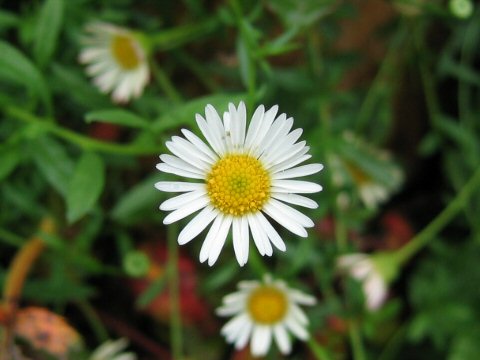
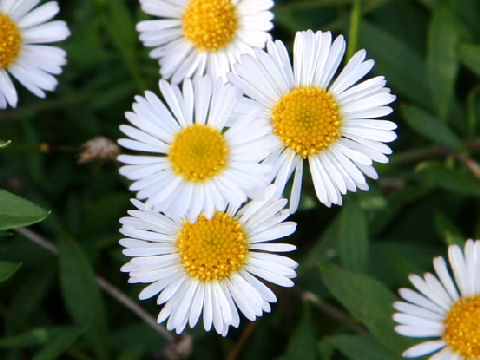
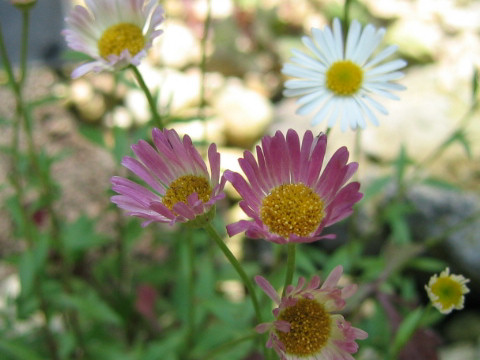
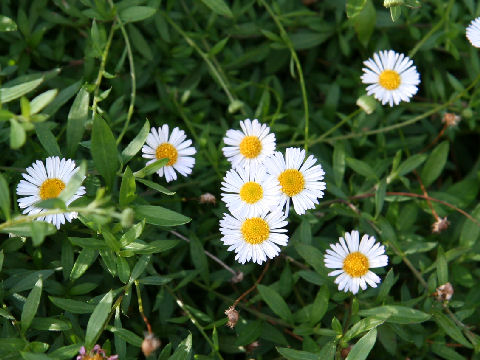
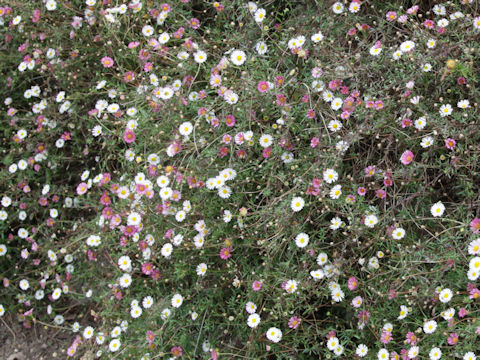
メキシコから中央アメリカ、それにベネズエラやチリに分布しています。わが国でも一部で帰化しているそうです。岸壁や荒れ地に生え、茎は匍匐して50センチほどの長さになり群生します。下部の葉は倒披針形で3裂し、上部の葉は線形から披針形です。5月から11月ごろ、小さな白い花を咲かせます。舌状花は時間が経つにつれて、ピンク色に変化します。
|
|
|
キク科ムカシヨモギ属の多年草で、学名は Erigeron karvinskianus。英名は Latin American fleabane、Mexican daisy。
|
|
|
The Latin American fleabane (Erigeron karvinskianus) belongs to Asteraceae (the Aster family). It is a perennial herb that is distributed from Mexico to Central America, as well as Venezuela and Chile. It is naturalized in some part of Japan. This herb grows in cliffs and waste grounds, up to a length of about 50 cm with trailing stems, and gregariously. The lower leaves are oblanceolate, divided into three lobes and the upper leaves are linear to lanceolate. The small white flowers bloom from May to November. The ray florets turn pink over time.
|
|
|
[上] 静岡県浜松市「浜名湖花博」にて、2004年09月19日撮影。
[中1・中3] 京都市左京区「京都府立植物園」にて、2006年10月25日撮影。
[中2] 大阪市鶴見区「咲くやこの花館」にて、2005年05月26日撮影。
[中4] イギリス・コーンウォール州「ランズエンド岬」にて、2011年08月21日撮影。(photo by Jon Suehiro)
[中5~9・下] 茨城県つくば市「つくば実験植物園」にて、2024年05月11日撮影。
|

 ぺらぺらよめな (ぺらぺら嫁菜)

 shu@botanic.jp